What Does “Best Quality” Vermicompost Really Mean?
Not all black compost is good compost.
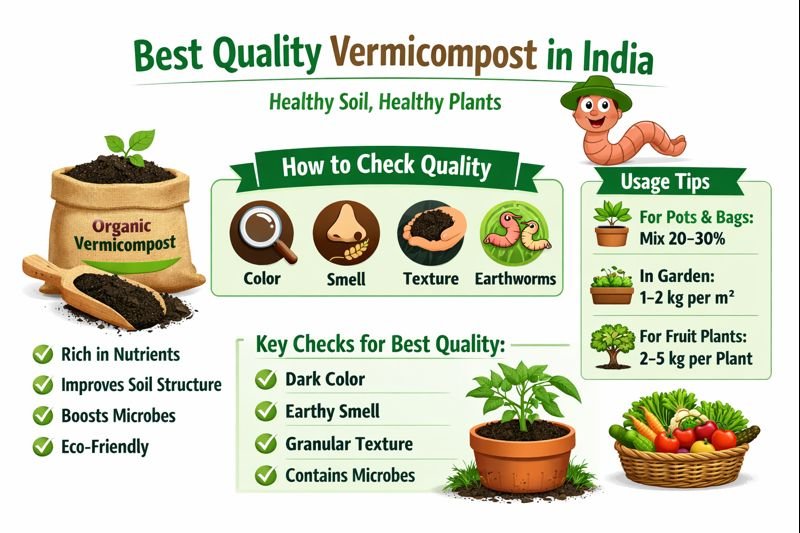
Best Quality Vermicompost in India means compost that is
Low-quality vermicompost is often mixed with soil, sand, or half-rotten waste, which gives very poor results.
How to Check Vermicompost Quality at Home (Very Easy Tests)
You don’t need a laboratory. Anyone can check quality using these simple mthods. If you truly want Best Quality Vermicompost in India, follow these steps carefully
1. Color Test (Rang Test)
✔ Good vermicompost:
Dark brown or black
Even color
❌ Bad quality:
2. Smell Test (Gandh Test)
This is the most important test.
✔ Good smell:
❌ Bad smell:
Bad smell means compost is not mature.
3. Texture Test (Haath Se Mehsoos Karo)
✔ Good texture:
Soft
Granular (dane-dar)
Breaks easily in hand
❌ Poor texture:
Sticky
Hard lumps
Clay-like feel
4. Life Test (Living Compost Check)
High-quality vermicompost may contain:
This shows the compost is alive and healthy.
5. Simple Plant Test
Use vermicompost on one plant and keep another without it.
✔ Good compost results:
Faster growth
Greener leaves
More flowers
This is the strongest proof of Best Quality Vermicompost in India
Common Mistakes People Make While Buying Vermicompost
Many buyers unknowingly purchase poor compost. Avoid these mistake if you want Best Quality Vermicompost in India
❌ Buying only because it is cheap
❌ Judging only by black color
❌ Ignoring bad smell
❌ Buying sun-dried, lifeless compost
Always touch, smell, and observe before buying.
Benefits of Using High-Quality Vermicompost
Using Best Quality Vermicompost in India improves plant health naturally and safely
🌿 Strong Roots
Roots grow deeper and absorb nutrients better.
🌼 More Flowers and Fruits
Natural hormones support flowering and fruiting.
🌱 Better Pest Resistance
Healthy soil builds plant immunity (rog-pratirodhak shakti).
🌍 Eco-Friendly
No chemicals, no polution, safe for soil and water.
How to Use Vermicompost Correctly
Even good compost gives poor results if used wrongly. For best results with Best Quality Vermicompost in India, follow these guidelines.
(Keyword count: 9)
For Pots & Grow Bags
For Vegetable Gardens
1–2 kg per square meter
Mix lightly with topsoil
For Fruit Plants
Storage Tips for Vermicompost
To maintain the quality of Best Quality Vermicompost in India, proper storage is very important
✔ Store in:
❌ Avoid:
Airtight plastic bags
Direct sunlight
Waterlogging
Wrong storage can kill microbes and reduce effectiveness.